{{ a.kind }}
{{ a.mins }}
{{ a.t }}
{{ a.d }}
In preparation
{{ t_langNote }}
The education ERP for universities, colleges and even schools. One governed record carries admissions, academics, research, fees, people and compliance across every level you teach, from K-12 through undergraduate, postgraduate, doctoral and post-doctoral. Sixteen interface languages, each institution’s data kept strictly its own.
9
Module groups
34
Functional domains
16
Interface languages
DSc → K-12
Every level covered
Enrolment, collection, attendance and open cases on the same screen, drawn from the same record. What you see is what the registrar, the accounts office and the principal see.
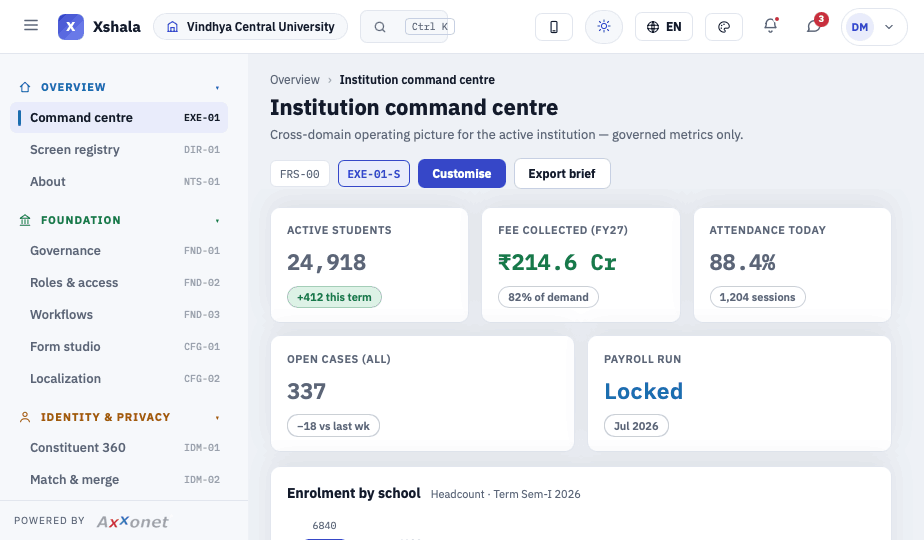
Four processes carry an institution’s year. Every enquiry, mark, receipt and approval lands in the same register, so nothing is re-keyed on the way from one to the next.
{{ p.k }}
{{ p.d }}
Turn on what you need this year and add the rest without a migration. Every module writes to the same student, staff and finance objects.
{{ m.d }}
{{ s.d }}
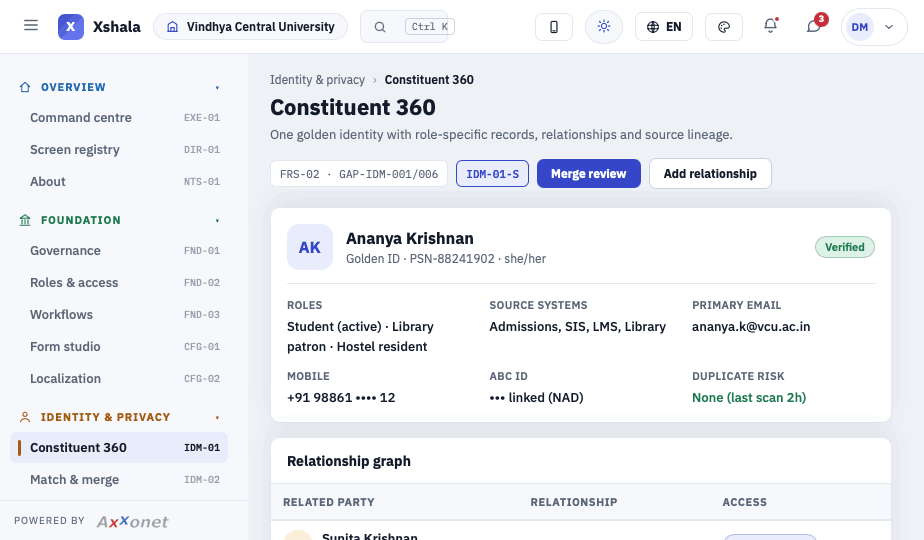
A student's golden identity carries their roles, source systems and relationships. Change an address once and the fee receipt, transport roster and guardian portal all agree.
A consultant walks the workflow with your registrar and accounts team, in your language, on your data model. No slide deck.
Nine module groups across 140+ screens, covering every level an institution teaches: school, undergraduate, postgraduate, doctoral, post-doctoral and higher doctorates such as the DSc. Each module reads and writes the same student, staff, fee and policy objects, so a change in one place is a change everywhere.
{{ m.d }}
Admissions carries the largest volume, the shortest deadlines and the most scrutiny of anything a university runs. Xshala treats it as a governed pipeline: policy is configuration, every rank is traceable, and a counselling round can be re-run to the same result.
Prospects, campaigns and agent sources, with marketing consent honoured per channel.
Versioned form schemas per cycle, conditional fields, correction windows and fee rules.
Entrance scores, board marks and weightings resolved into a ranked pool with tie-breaks.
Seat pools, category quotas, choice filling, upgrades and vacancy carry-forward.
Firm, conditional and waitlist offers with expiry, deposit capture and an appeal route.
One student number, cohort, accounts and opening fee demand. The applicant record stays attached.
Run the round again from the same inputs and get the same result. Every offer stores the rule version, evaluated rank, category and tie-break used.
Seat pools, category quotas, supernumerary seats and carry-forward follow a versioned policy document an auditor can read alongside the result.
Document verification, equivalency review for international qualifications and fraud flags that gate progression, against an immutable snapshot taken at submission.
Admit to student runs idempotently. Re-running the batch never creates a second student; failures land in an exception queue instead of a duplicate record.
Fees, attendance, timetable, results and circulars, with consent and notice history visible to the family.
Attendance, marks entry and approvals sized for a phone, with the same permissions as the desktop console.
Answers policy and deadline questions against your own regulations and quotes the clause it used. It recommends; a human decides.
Eight Indian and eight international languages, including right-to-left Arabic. Records stay in the language they were captured in.
An ERP sits at the centre of a campus, not alone on it. These are the seams Xshala is built to hold.
Online collection with gateway reconciliation built into the fee ledger, so the bank statement and the receipt register agree without a spreadsheet between them.
Attendance captured at the device lands in the same registers staff and families see, under the same role-scoped permissions.
Teaching stays in the LMS; the record of truth stays here. Rosters flow out, outcomes flow back, and neither system pretends to be the other.
Where the seam belongs →Circulars, alerts and fee reminders reach families over email and SMS, with consent honoured per channel and the notice history kept on the record.
The integration inventory is confirmed against your environment during evaluation. Ask for the current brief.
The same modules, configured to how each kind of institution actually runs its year, from a multi-campus research university to a single school.
{{ s.d }}
Every deployment follows the same sequence, proved in parallel with your existing trackers before anything is retired. It starts where families notice and trust is won: collection.
{{ p.i }}
{{ p.d }}
Names an owner for every register, decides which sheet wins where two disagree, and signs off each phase before the next begins.
Configuration, migration runs and reconciliation reports, training for two staff cohorts, and the first collection day with both teams present.
Tell us the modules and the number of institutions and we quote against that. No per-seat surprises at renewal.
{{ p.d }}
Six differences that show up in the second year, not the demo.
{{ d.d }}
| Dimension | Typical legacy ERP | Xshala |
|---|---|---|
| {{ c.k }} | {{ c.a }} | {{ c.b }} |
Comparison describes patterns common to on-premise and first-generation cloud deployments. It is not a claim about any named product.
Xshala is built for institutions that answer to a board, a regulator and a parent. Here is what that means in the product.
{{ s.d }}
Regulators ask for records the institution should already hold. Xshala keeps them governed as a by-product of daily operation, so a return is a report, not a project.
An accreditation cycle asks for enrolment, outcomes, finance and governance data over five years, with evidence attached. The record keeps that shape from day one, so the self-study draws from the register instead of a spreadsheet built the month before the visit.
Read the accreditation guide →Credit frameworks, electives with capacity rules and programme structures from certificate to doctorate are configuration, not custom work. When policy moves, the academic record moves with it.
Statutory reporting runs from governed report definitions, so the number filed is the number the register holds. Two people asking the same question get the same answer.
Consent register, notice history, purpose limitation and retention schedule are product surfaces. A data-principal request is answered from the record, not reconstructed for it.
Read the DPDP explainer →Marks move through entry, verification, moderation and publication with an immutable trail. When a result is challenged, the register answers with who, when and under which policy version.
Read the custody explainer →High-contrast modes, reading spacing, text scaling, full keyboard operation and reduced motion ship in the product, for staff and for the families who use the portals.
Data-processing terms, sub-processor list, retention schedule and the accessibility conformance statement are available to institutions under evaluation.
Implementation guides and policy explainers written for registrars, principals and accounts teams. First pieces publish from August 2026.
{{ a.d }}
{{ a.d }}
The questions procurement forgets to ask any vendor, ours included: migration, training cohorts, integration ownership and what happens at renewal.
Read before you shortlist →A week-by-week reference plan for moving off spreadsheets without losing a term, starting with fee collection.
Read the plan →Data-processing terms, sub-processor list, retention schedule and the accessibility conformance statement, for institutions under evaluation.
Request the documents →One email per guide. Nothing else, and no sharing with anyone.
Axxonet has spent more than twenty years building systems: enterprise data platforms, medical devices, neuro research instrumentation and homeland-security software. Xshala applies that learning and discipline to the institutional record.
The group is certified to ISO 9001:2015 with Design by TÜV SÜD and operates from India, the United Kingdom, Finland and the United States.


{{ d.d }}
Tell us how your institution is shaped and which processes hurt. We will come back with a walkthrough against your own term dates and fee policy.
A consultant will reply to {{ sentTo }} within one working day. If it is urgent, call +91 80 41508919.
It depends on your modules and your data, so we commit to a sequence rather than a slogan: fee collection first, proved in parallel against your existing tracker, then identity, academics and a cutover date fixed in writing. A week-by-week reference plan for a single institution is published in the migration guide.
Yes. Turn on what you need this year and add the rest without a migration. Every module writes to the same student, staff and finance objects, so later modules inherit the record instead of importing it.
One platform, one isolated tenant per institution. A branch user cannot cross the boundary; a group console reads across it for trustees, so you can compare without merging and report without exporting.
Yes. Assessment configures to the affiliating university’s calendars and returns, with sealed internal marks, or runs the full examination suite for autonomous institutions: scheduling, moderation, revaluation and transcripts.
The institution does. Each tenant’s data is strictly its own, retention follows a schedule you can read, and the data-processing terms, including return and deletion, are available to institutions under evaluation.
Sixteen: eight Indian and eight international, including right-to-left Arabic. The interface switches per user; records remain in the language they were captured in, so nothing is lost in translation at audit.